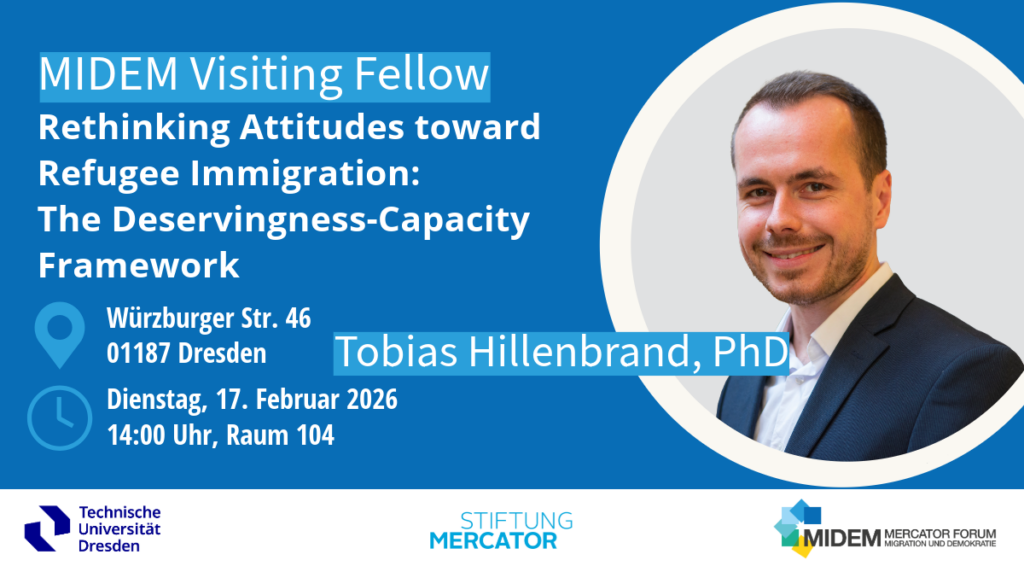
Immigration has become an increasingly contentious and politicized issue in European societies, prompting a growing body of scholarship. Yet important gaps remain in explaining overall attitudes toward immigration. First, many studies rely on empirical models with only modest explanatory power. Second, although views toward refugees are increasingly recognized as distinct from general immigration attitudes, research in this subfield continues to draw on more general theories.
Building on theoretical work in migration studies and related fields, Tobias Hillenbrand proposes a Deservingness–Capacity Framework, which conceptualizes refugee attitudes as the joint outcome of perceived refugee deservingness and perceived host-society capacities, each broken down into analytically distinct subcomponents. The framework is developed using qualitative data from a large sample of the German population.