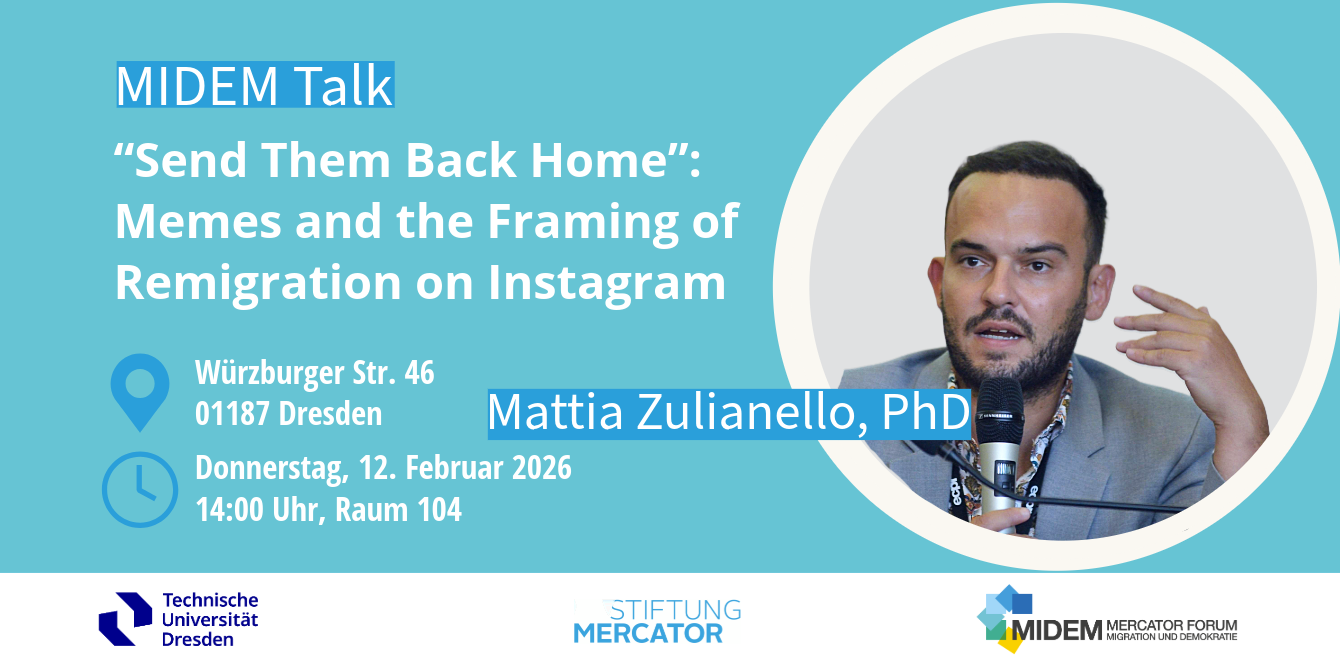
In this lecture Mattia Zulianello will examine in his how the contemporary extreme right mobilizes and frames remigration as an emerging political issue through social media communication. Remigration refers to the demand for the large-scale return of immigrants—and, in some interpretations, their descendants—to their countries of origin, often justified through ethno-cultural, security, or civilizational arguments. While long present in extremist milieus, remigration has recently gained renewed visibility and salience, especially in online environments, where it is increasingly normalized and reframed as a legitimate policy option.
Empirically, the study focuses on a selected number of Instagram pages that are ideologically and/or symbolically connected to extreme right milieus. These pages do not necessarily represent formal party organizations, but rather function as informal hubs of political communication, blending activism, subcultural references, and digital creativity. Using qualitative content analysis, the article investigates how remigration is framed, which symbolic repertoires are activated, and how boundaries between “us” and “them” are constructed through visual and textual elements.
Special attention is devoted to the central role of memes in the dissemination of remigration narratives. Memes are shown to be particularly effective communicative devices because they condense complex and exclusionary messages into simplified, humorous, and emotionally resonant formats. By relying on irony, satire, and ambiguity, memes allow extreme right actors to communicate radical ideas while lowering the threshold of acceptability and reducing the risk of overt stigmatization or platform sanctions. At the same time, memes foster in-group recognition and shared identity, reinforcing a sense of belonging among followers.
By highlighting the visual, affective, and humorous dimensions of extreme right communication, this article contributes to the growing literature on digital radicalization and issue entrepreneurship. It shows how remigration is strategically constructed as a “new” topic through online practices that blur the boundaries between entertainment and political mobilization, thereby facilitating the diffusion and normalization of exclusionary ideas in contemporary social media ecosystems.